
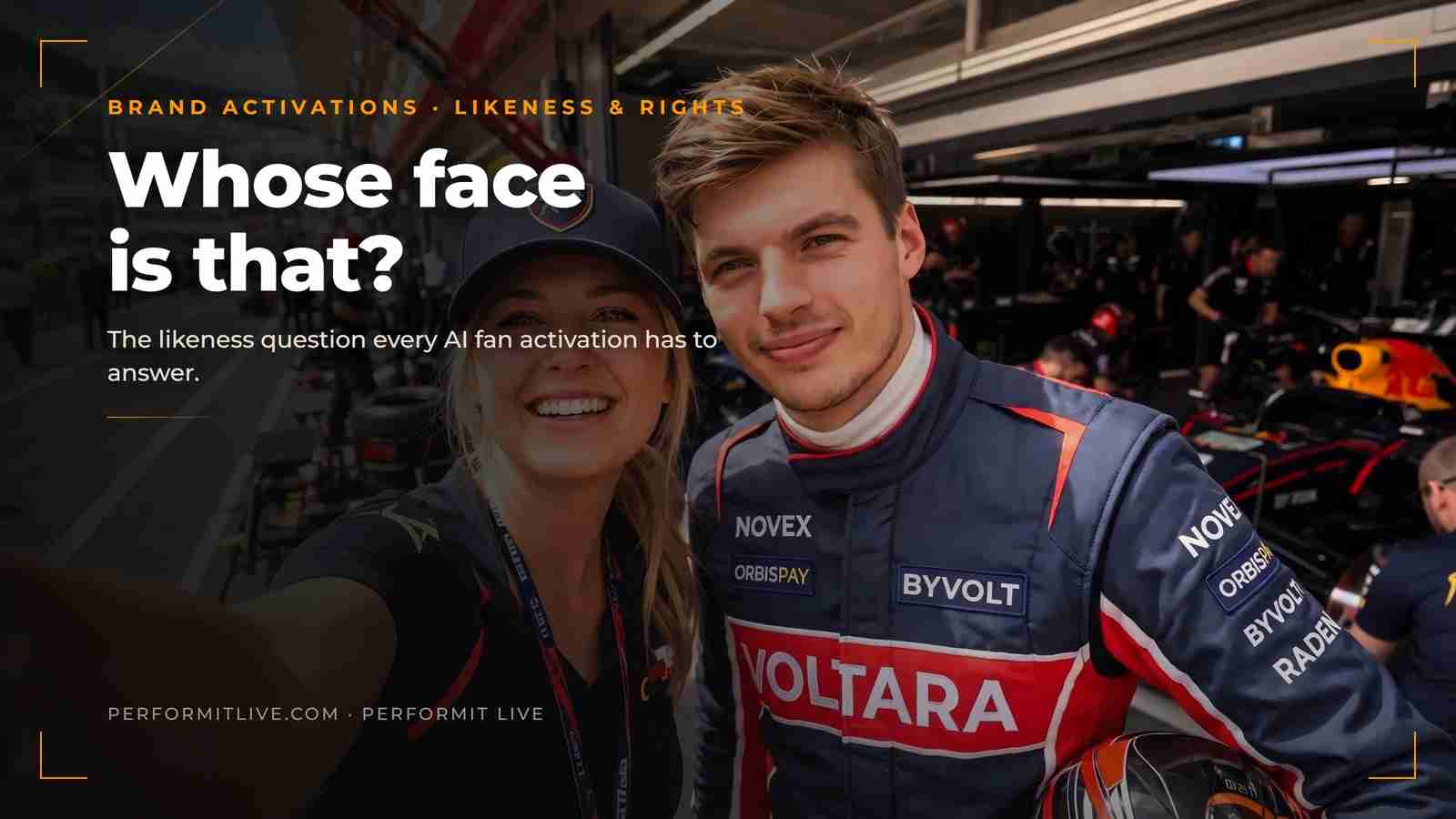
Every fan wants a photo with the hero. The moment you offer that with AI, a lawyer somewhere sits up. Whose face is that. Who said you could use it. And what happens to the guest’s face after they walk away. Answer those three well and you have a brand activation people share. Answer them badly and you have a liability with a queue.
For any AI fan activation, use a generic or owned character by default, and only feature a real, named person when their likeness rights are licensed in writing. Treat the guest’s photo as consented first-party data the property owns, captured with permission and handled to local law. Rights on both faces in the frame, or the activation does not run.
The law is catching up, fast
For years, likeness sat under a patchwork of state right-of-publicity rules. AI changed the pace.
In March 2024, Tennessee passed the ELVIS Act, the first law to expressly protect a person’s name, image, likeness and voice against AI cloning, effective 1 July 2024 (Holland & Knight, ArentFox Schiff). At the federal level, the NO FAKES Act would create a national right against unauthorised AI replicas of a person’s voice and likeness. It was introduced in 2024, reintroduced in 2025 with backing from Google and the recording industry, and a Senate committee advanced likeness-protection legislation again in 2026 (Holland & Knight).
The takeaway for anyone running an activation is plain. Putting a recognisable person on a screen without a licence is moving from risky to unlawful. There is still no single federal right of publicity, so the rules vary by state and by country. That is a reason to license, not a loophole.
Two faces, two sets of rights
An AI fan activation has to clear rights on both faces in the frame.
The hero’s face. If the character is a real athlete, driver, or musician, that is their name, image and likeness. It needs a licence, in writing, for the specific use. The clean alternative is a character you own outright: a mascot, an original AI host, or a historical figure. Generic by default. A licensed hero as a paid upgrade, secured as part of the build.
The guest’s face. The moment you capture a guest, you are processing their image. Under the GDPR, a facial image used to identify a person is biometric data and a special category under Article 9, which needs explicit consent and a documented legal basis. This is enforced, not theoretical: in 2024 the UK’s Information Commissioner’s Office took enforcement action over facial recognition used without a lawful basis. Consent is not a box you bury in the small print. It is captured in the flow, and the guest knows the image is AI-assisted.
The model that is both safe and commercial
Here is the part most vendors skip. Doing rights properly is not a tax on the activation. It is what makes the data worth having.
- Generic by default. The booth ships with an owned or original character, so it runs anywhere with no licence risk.
- Licensed hero as an upgrade. When a sponsor wants a named face, the likeness rights are secured for that use, in writing, as part of the build.
- Consent-first capture. Every photo is taken with permission, and every record is first-party data the property owns, not a third-party audience it rents.
That last point is where the commercial case lives. Safari and Firefox already block third-party cookies by default across more than a third of US browsers, and brands are leaning harder on data they own (Amperity). A consented photo activation, run cleanly, produces exactly that. A real interaction. A real record. Permission to come back. Owned, not rented.
What to ask any vendor before you sign
- Whose face is on the screen, and where is the licence.
- What happens to my guest’s face after the photo, and where is the consent.
- Who owns the data at the end, me or you.
If a vendor cannot answer all three in writing, the risk is yours, not theirs.
Frequently asked questions
Can we use a famous athlete or musician in the booth?
Yes, where the likeness rights are licensed in writing for that use. By default the booth runs a generic or owned character, and a named hero is added as a licensed upgrade, handled as part of the build.
Who owns the guest photos and data?
The guest gets a shareable copy. The property owns the first-party records, captured with consent.
Is a consent form enough under GDPR?
Facial images used to identify a person are a special category under Article 9, so they need explicit consent and a separate documented legal basis, not a single buried checkbox.
What if we run the activation in the GCC or outside the EU?
Consent and data handling are set to the rules of the region the booth runs in, not a single one-size template.
Does licensing a hero cost more?
Yes. The number depends on the person, the use, and the run. We scope it on a call rather than publish a price.
A green-screen booth takes a face and hopes. A brand activation photo booth, done right, licenses the face on the screen, consents the face in front of it, and hands you a record you own. Rights are not the thing that slows the activation down. They are the thing that makes it worth running.
See how we handle heroes and rights → performitlive.com/ai-photo-booth
Is your organisation ready to deploy an AI character?
Take the free AI Readiness Assessment. Score your venue on AI character readiness in 2 minutes. Personalised PDF report.