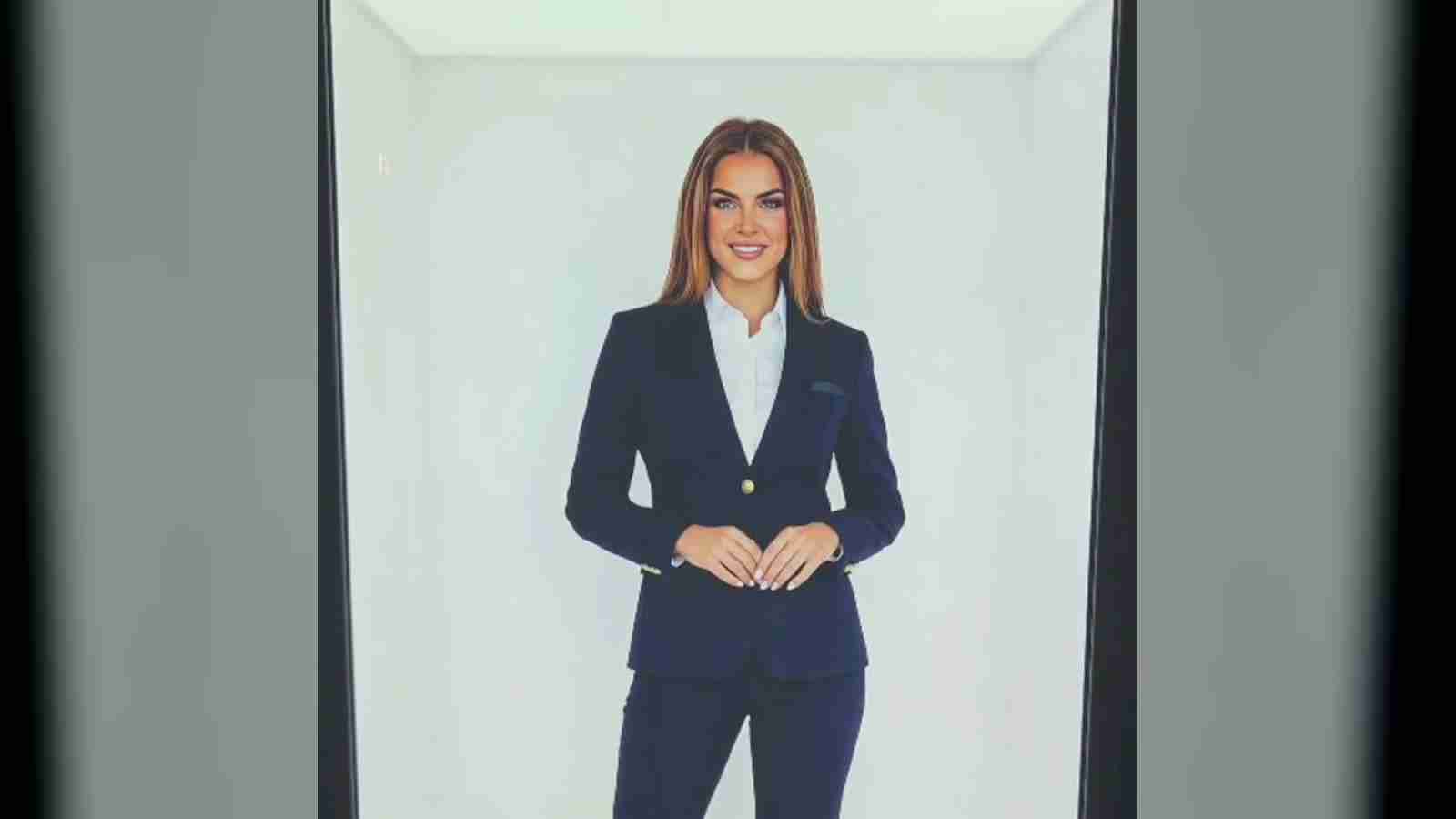
Digital out-of-home advertising has been a one-way broadcast: the screen plays, you watch. A digital human turns it two-way, a real-time AI character that converses with the person in front of the screen. Amira, live with JC Decaux in Paris, is what that looks like.
A digital human in DOOH does not make the broadcast smarter. It makes the screen conversational. For twenty years the argument in out-of-home advertising was about the buy. Better data, better targeting, programmatic pipes that place the right video in front of the right footfall at the right hour. All of it improves the broadcast. None of it changes the fact that the screen still only broadcasts. The person standing in front of it watches a loop and walks on. A digital human changes the thing the audience actually experiences: the screen stops talking at them and starts talking with them.
A digital human in DOOH is a real-time AI character on an out-of-home screen that converses with people in the space, instead of only broadcasting an ad. It advertises when idle, converses when a person approaches, and learns from every interaction. Unlike a standard DOOH ad (a one-way video) or a touchscreen menu, it holds a live conversation, in multiple languages, on the screen.
Amira, a Performit Live real-time digital human, live on the JC Decaux screen in Paris.
What “digital human in DOOH” means
A DOOH screen broadcasts. A digital human converses. The difference is whether the screen talks at you or with you.
A standard digital out-of-home advertising unit runs a video on a loop. It is a one-way format by design: the same fifteen seconds, played to everyone who passes, whether they stop or not. A touchscreen is a step closer to the person, but it is still a menu. You tap through options someone laid out in advance. Neither one holds a conversation.
A digital human is a real-time character. Someone approaches, speaks, and the character answers in natural language, then and there, about the brand, the product, the space they are standing in. This is the digital human vs AI avatar vs conversational AI distinction applied to a screen you already own. The category term is not the bare “digital human”. It is the digital human in DOOH: a conversational character living where the ad used to be.
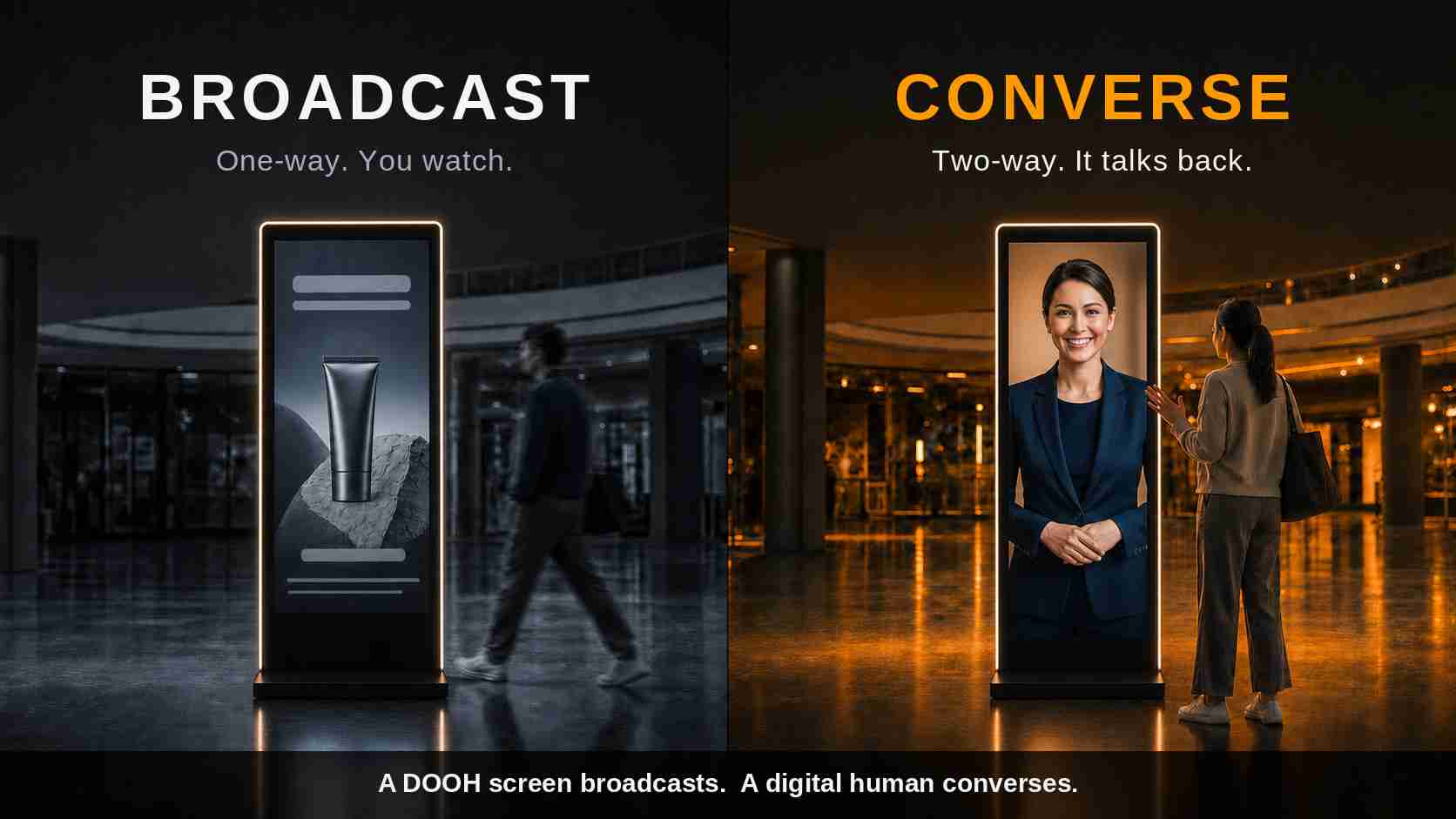
Left: a standard DOOH ad plays to a passer-by. Right: a digital human holds a conversation with someone who stopped.
From broadcast to conversation: why DOOH advertising is going two-way
Ad spend is moving to in-venue screens, and the Gulf is digitising fastest. Programmatic made the buying smarter. Interactive DOOH makes the screen itself two-way, the part the audience actually experiences.
The money is already moving. In 2025, UK out-of-home grew 2.3% and retail media grew 17.5%, according to the Advertising Association / WARC Expenditure Report. Retail media is where the growth is, and a large share of retail media is the screen inside the venue, next to the shelf, on the concourse, at the entrance. The Gulf is digitising out-of-home faster than most Western markets, pushed by Saudi Vision 2030 and Dubai smart-city screen programmes that are putting displays into malls, transit, and public space at pace.
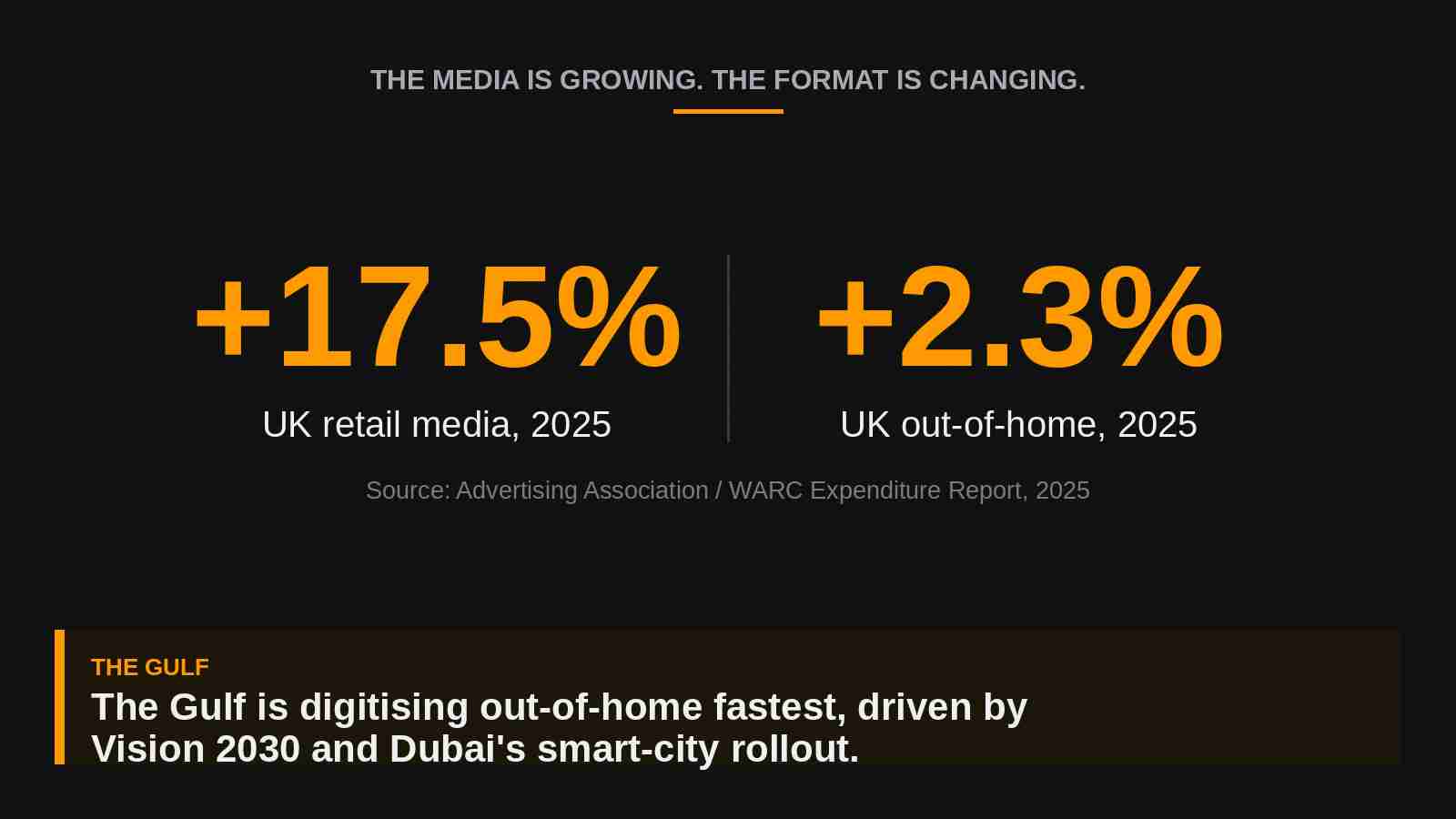
Ad spend is following the audience into the venue.
Programmatic DOOH solved the buying. It automated how inventory gets bought and placed, and it made spend more accountable. What it did not touch is the screen itself. A programmatically bought ad is still a one-way video. The next step is not a smarter way to buy the broadcast. It is interactive DOOH: making the broadcast itself two-way, so the impression becomes an interaction. That is conversational out-of-home, a screen that responds instead of repeats.
What a real-time digital human adds: advertise, converse, learn
A static ad does one job. A digital human advertises, then talks, then learns, three jobs on the same screen.
This is Performit Live’s Closed Loop, running on a single out-of-home screen:
- Advertise (when idle). The character runs the brand’s advertising to everyone who passes, the same job a standard DOOH ad does today.
- Converse (when approached). Someone stops and speaks. The character answers in real time, in natural language, in multiple languages, about the brand and the space.
- Learn (every interaction). Every conversation is a first-party signal: what people asked, what held them, what they wanted next. That intelligence sharpens the next impression, so the loop closes.
A static ad cannot do the second and third jobs. It shows, and it forgets. The character is powered by Lumière AI, Performit Live’s own real-time engine, not a reskin of an off-the-shelf tool, which is what makes the low-latency conversation and the owned-data layer possible on the screen rather than in a separate app.
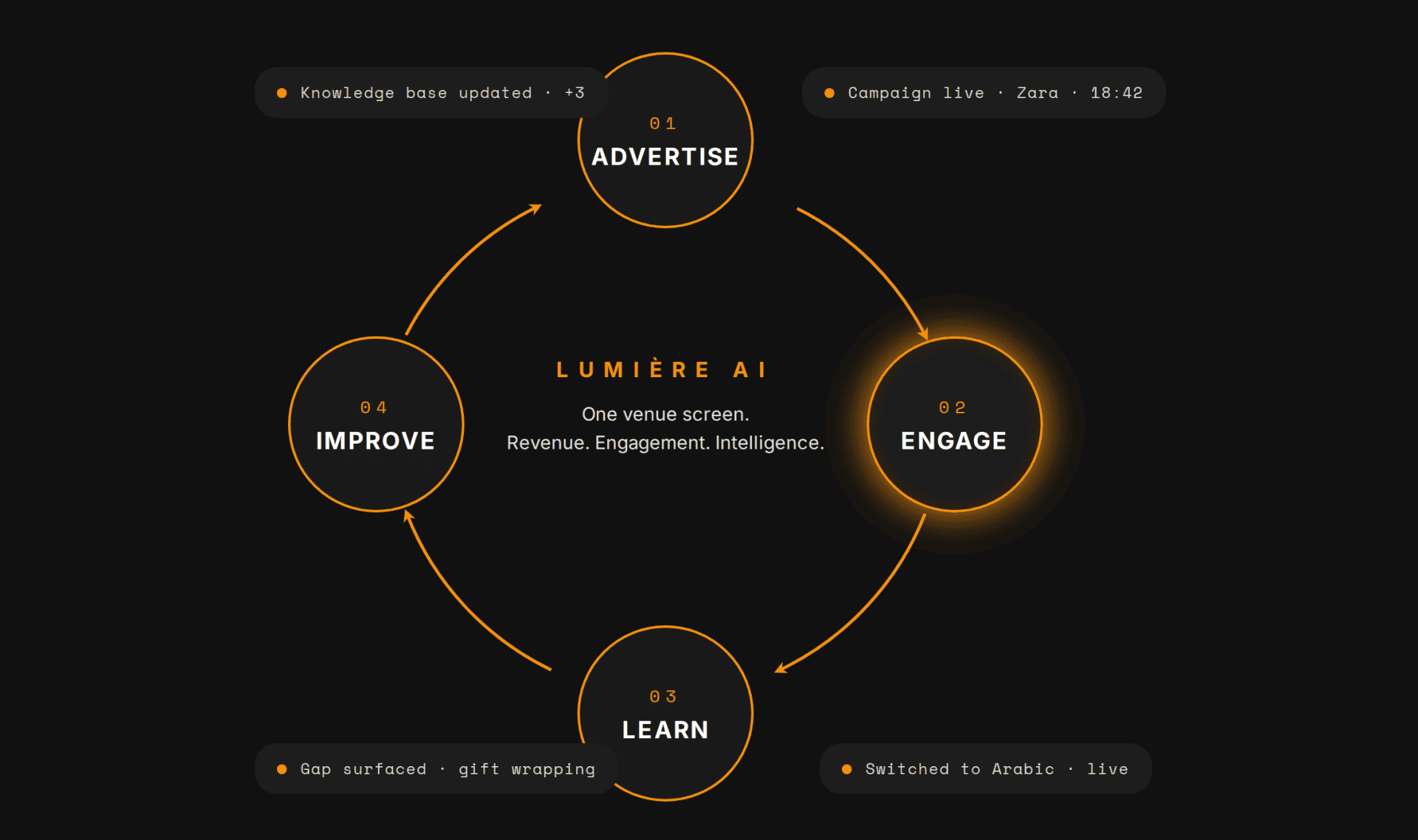
On an out-of-home screen, the loop runs where the ad used to sit.
Amira at JC Decaux, Paris
A digital human in live out-of-home is not a concept. Amira is on a JC Decaux screen in Paris now.
Amira is a Performit Live real-time digital human, live on location with JC Decaux in Paris: a character conversing in a premium out-of-home environment, in the same media context where a standard DOOH ad would run. It is a working example of the shift this post describes, on a media owner’s screen, in a capital city, today.
It is not the only out-of-home proof point. Performit Live delivered an AI digital-character activation for Universal Pictures’ M3GAN 2.0 with Ocean Outdoor, a digital character in a live out-of-home advertising format. Two named out-of-home deployments, one with a global media owner and one with a global studio, both putting a digital character on the screen instead of a broadcast loop.
What it means for advertisers and media owners
Advertisers buy attention they can measure. A conversation is a stronger signal than a play count, and it is captured with consent.
A broadcast ad sells a guessed impression. Someone was in front of the screen, probably, for a moment, maybe. A conversation is a measured one: a person chose to engage, for a length of time you can see, about a subject they raised. Dwell and conversation are harder signals than a modelled impression, and they belong to the operator, not to a third-party panel.
Two questions decide whether that signal is worth anything. The first is who owns the engine. Lumière AI is Performit Live’s own IP, which means the data the screen captures is a first-party asset the operator holds, not something rented back through a vendor’s platform. The second is governance. The capture is consented, gated, and non-deviating. No individual or child data. A character that stays on-brand and does not wander off it. For an audience of media owners and brand marketers, that is the difference between a signal you can build on and a liability you have to explain.
The screen you already run can do more than play. It can advertise, converse, and learn, on the same glass, in the same media buy. That is what a digital human adds to out-of-home.
See Lumière AI, the real-time engine behind the character. Read how screens earning nothing can start earning attention. Or book a demo to see a digital human converse on your screen.
Frequently asked questions
What is a digital human in DOOH?
A digital human in DOOH is a real-time AI character on an out-of-home screen that converses with people in the space, instead of only broadcasting an ad. It advertises when idle, converses when a person approaches, and learns from every interaction. Amira, live with JC Decaux in Paris, is a working example.
What is the difference between DOOH advertising and a digital human screen?
A standard DOOH advertising screen broadcasts a video on a loop, one-way, the same content to everyone who passes. A digital human screen holds a two-way conversation: the character answers people in real time, in natural language, about the brand and the space they are standing in. One talks at the audience. The other talks with them.
What is the difference between programmatic DOOH and a conversational digital human?
Programmatic DOOH automates how out-of-home inventory is bought and placed, making the buying smarter. The ad it delivers is still a one-way video. A conversational digital human changes the screen itself: instead of playing a broadcast, the character converses with the person in front of it and captures that interaction as first-party data.
Can a digital human in advertising respond in real time?
Yes. A digital human responds in real time, holding a live conversation in natural language and in multiple languages. Amira, live with JC Decaux in Paris, is a real-time character conversing on an out-of-home screen. The low-latency response is powered by Lumière AI, Performit Live’s own engine.
Where is a digital human used in out-of-home advertising?
Amira, a Performit Live real-time digital human, is live with JC Decaux in Paris, conversing in a premium out-of-home environment. Performit Live also delivered an AI digital-character activation for Universal Pictures’ M3GAN 2.0 with Ocean Outdoor, a digital character in a live out-of-home advertising format.
Is the interaction data captured with consent?
Yes. The interaction is captured with consent, gated, and non-deviating. No individual or child data is collected. The data is a first-party asset the operator owns, because the character runs on Lumière AI, Performit Live’s own engine, rather than a third-party platform.
What powers a real-time digital human (which AI engine)?
A Performit Live digital human runs on Lumière AI, the company’s own real-time engine and owned IP, not a reskin of an off-the-shelf tool. Owning the engine is what makes low-latency conversation on the screen and a first-party, operator-owned data layer possible.
Is your organisation ready to deploy an AI character?
Take the free AI Readiness Assessment. Score your venue on AI character readiness in 2 minutes. Personalised PDF report.