For the past several years, the conversation around artificial intelligence has been dominated by the invisible. We have focused on backend algorithms that optimise supply chains, generative models that write code, and chatbots that live inside browser tabs.
But as we move through 2026, a distinct discipline has emerged, one that is fundamentally changing how people interact with technology in cities, stores, and venues.
We call this Physical AI.
Physical AI is the discipline of deploying digital characters, avatars, and agents into shared physical environments where they interact with real people in real time. It is not an app on a smartphone. It is not a web-based chatbot. It is not a general-purpose Large Language Model hidden behind a text box. Physical AI is a public-facing brand representative with a physical presence, situational awareness, and the ability to navigate the complex social rules of the human world.
Why Now? The Convergence That Made This Possible
The emergence of Physical AI is not speculative. It is a response to several forces that have matured simultaneously.
Real-time generation has crossed the threshold. We can now generate lifelike voices and facial expressions with millisecond latency, allowing for fluid, natural conversation that feels human rather than scripted.
Display hardware has gone enterprise-grade. Holographic projection and high-fidelity display systems have moved from prototype novelty to reliable infrastructure that can run twelve hours a day in a public venue.
The experience economy has exploded. The global experiential market is valued at over $132 billion and growing. Brands are investing heavily in physical spaces to meet the expectations of Gen Z and Gen Alpha generations for whom interacting with a screen that does not talk back or “see” them already feels like a relic of the past.
Post-pandemic priorities have shifted. Venue operators, retailers, and cultural institutions are under pressure to deliver differentiated, memorable experiences that justify physical visits.
Static signage and passive displays no longer move the needle. These factors have not arrived sequentially. They have converged and that convergence is what separates Physical AI from the digital signage experiments of the previous decade.
Proof of Presence: Physical AI Is Already Live
This is not a whitepaper concept. Physical AI is operating commercially today, across multiple
sectors and geographies.
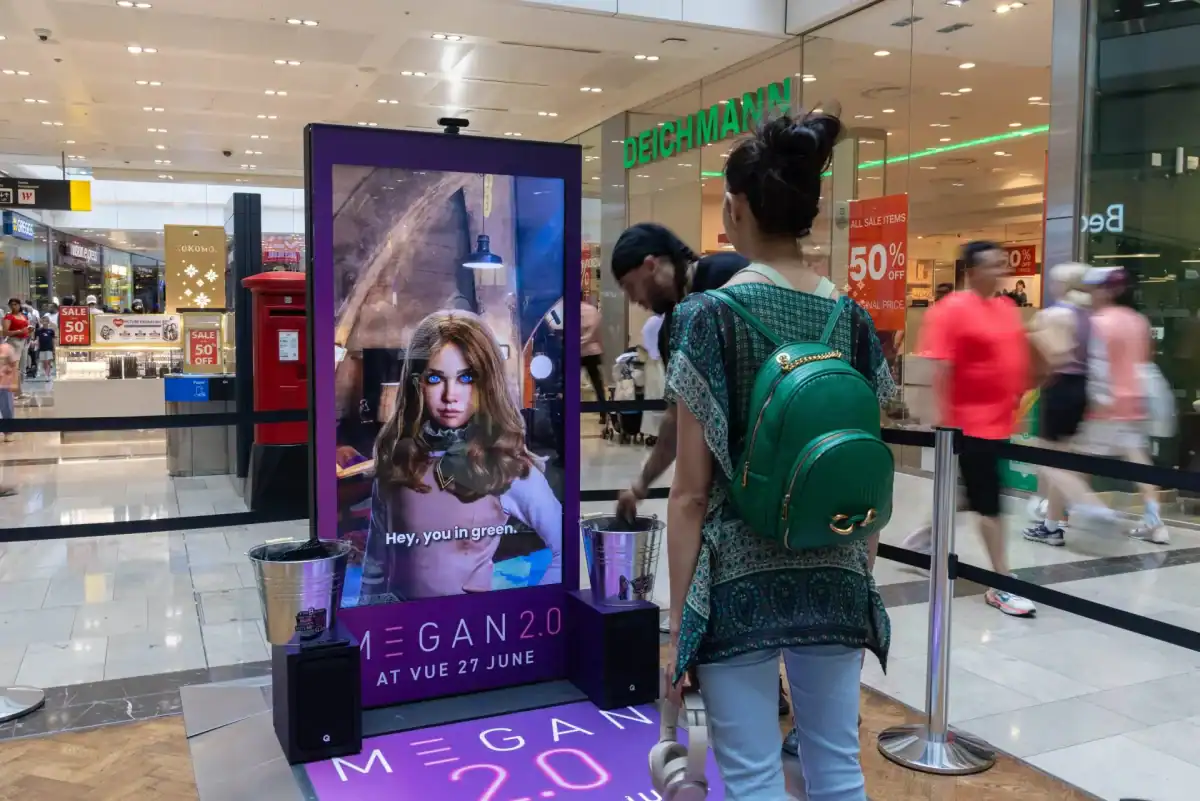
In entertainment, the M3GAN 2.0 Project brought a digital character into a live event space
where she engaged with fans in real time — responding to questions, reacting to crowd energy,
and delivering interactions that audiences described as startlingly real. The deployment
demonstrated that AI characters can hold public attention at scale, not just in a controlled demo
room.

In heritage, Waterloo Uncovered used a digital character to bring history to life, allowing visitors
to converse with a Coldstream Guard from the Battle of Waterloo. These are not static museum
displays. They are dynamic, interactive agents that respond to each visitor differently, creating
the kind of personal engagement that traditional interpretation panels cannot replicate.
In retail, AI characters are now operating in premium mall environments across multiple regions serving as brand ambassadors, wayfinding assistants, and engagement drivers in high-footfall spaces. Early deployments have shown measurable increases in visitor dwell time and interaction rates compared to traditional digital signage.
These deployments share a common lesson: the technology is ready. But the technology is only
twenty percent of the story.
The Five Layers of Physical AI
A successful Physical AI deployment is not a single piece of technology. It is the integration of
five distinct disciplines. When these layers are designed together from the start, the character
becomes a seamless part of the environment. When even one layer is treated as an
afterthought, the deployment fails.
- The Character Layer
This is the brand surface of how AI presents itself to the world: its visual design, voice, personality, mannerisms, and the “no list” that defines what it will never say or do. Everything a visitor sees, hears, and remembers lives in this layer. It is the emotional interface of the brand. A well-designed Character Layer does not just make the AI look good. It makes the AI feel appropriate for the venue, for the audience, and for the brand it represents. - The Intelligence Layer
This is the brain. It includes the language models, proprietary knowledge bases, safety guardrails, and response logic that power what the character says and does. This layer determines whether interactions feel fluent and grounded or rehearsed and brittle. The critical distinction: Physical AI characters do not run on the open internet. They operate on isolated, curated knowledge bases that prevent the hallucinations and off-brand responses common in unmanaged AI systems. - The Environmental Layer
This is where the AI stops being software and starts being a physical presence. It encompasses the displays, holographic projection, spatial audio, cameras, sensors, lighting, and connectivity that bring the character into the space. The Environmental Layer is what allows a character to look a guest in the eye, react when a crowd gathers, and adjust its behaviour based on the physical context around it. Without this, the character is just a video on a screen. - The Governance Layer
This is the layer most organisations skip and the one that separates deployments that scale from ones that fail quietly. The Governance Layer covers the policies, protocols, and accountability structures that determine who owns the deployment, how incidents are handled, what data is collected, and how the system is monitored in real time. It includes data privacy compliance, content moderation policies, and the escalation paths that activate when something unexpected happens. When an AI operates in a private digital space, governance risks are manageable. When it operates in a public venue surrounded by children, press, and social media the risks are magnified. - The Human Layer
Physical AI does not exist in a vacuum. It is surrounded by front-of-house staff, operational owners, escalation contacts, and the team that trains, monitors, and manages the character day to day. The Human Layer is what turns a technology installation into an operational asset. It includes the people who can step in when the AI encounters a situation it was not designed for a distressed visitor, a press inquiry, or a technical fault during peak hours. Without it, even the most sophisticated deployment collapses under the weight of its own complexity.
Physical AI works when all five layers are designed together from the start. It fails almost
without exception when one layer is treated as the deployment and the other four are
treated as an afterthought.
The Trust and Governance Challenge
Here is the defining thesis of this new category:
Physical AI is not defined by the technology. It is defined by the environment it operates in,
and the operational discipline required to run it responsibly.
When an AI operates behind a login screen, the worst case is a bad user experience. When it operates in a shopping centre, a heritage site, or a live event surrounded by families, and smartphones the stakes are fundamentally different.
This is why the conversation must move away from “what can the AI do?” and toward “how do
we govern what it does?”
The organisations that will lead in Physical AI are not the ones with the most advanced language models. They are the ones that build governance into the foundation treating accountability, monitoring, and human oversight as first-class requirements rather than compliance checkboxes
to handle after launch.
The technology is ready. The question now is whether the operational discipline will keep pace.
Assess Your Readiness
Physical AI represents a new chapter in the relationship between humans and machines. It requires a shift in mindset from building tools to building a new class of digital presence that demands a holistic, disciplined approach across all five layers.
Before you invest in a deployment, it is worth understanding where your organisation stands today. We have built a free diagnostic tool that evaluates your project across the five layers and identifies the gaps most likely to derail a deployment.
Frequently Asked Questions
How does Physical AI differ from a standard chatbot?
A chatbot is a text-based tool designed for private, asynchronous communication. Physical AI is an embodied, synchronous agent designed for public spaces. It uses vision and audio sensors to perceive its environment and the people within it, enabling socially appropriate, two-way interaction that a standard chatbot cannot replicate.
What is the most important layer for a successful deployment?
While all five layers are essential, the Governance Layer is often the difference between success and failure. Without clear protocols for monitoring, data privacy, and incident response, a Physical AI deployment cannot scale or maintain the trust of the brand or the public over the long term.
Can Physical AI characters see and hear guests in real time?
Yes. The Environmental Layer includes cameras and microphones that allow the AI to perceive its surroundings. This data is used to trigger contextual responses — such as the character turning to face someone as they approach — but it is managed through the Governance Layer to ensure guest privacy is protected and no personal data is stored unnecessarily.
How do you prevent a Physical AI character from saying something off-brand?
This is managed through the Character and Intelligence Layers working together. A “no list” of prohibited topics defines hard boundaries, while the AI operates on a proprietary, isolated knowledge base rather than the open internet. This combination ensures the character remains a consistent, safe representative of the brand’s values.
Is your organisation ready to deploy an AI character?
Take the free AI Readiness Assessment. Score your venue on AI character readiness in 2 minutes. Personalised PDF report.