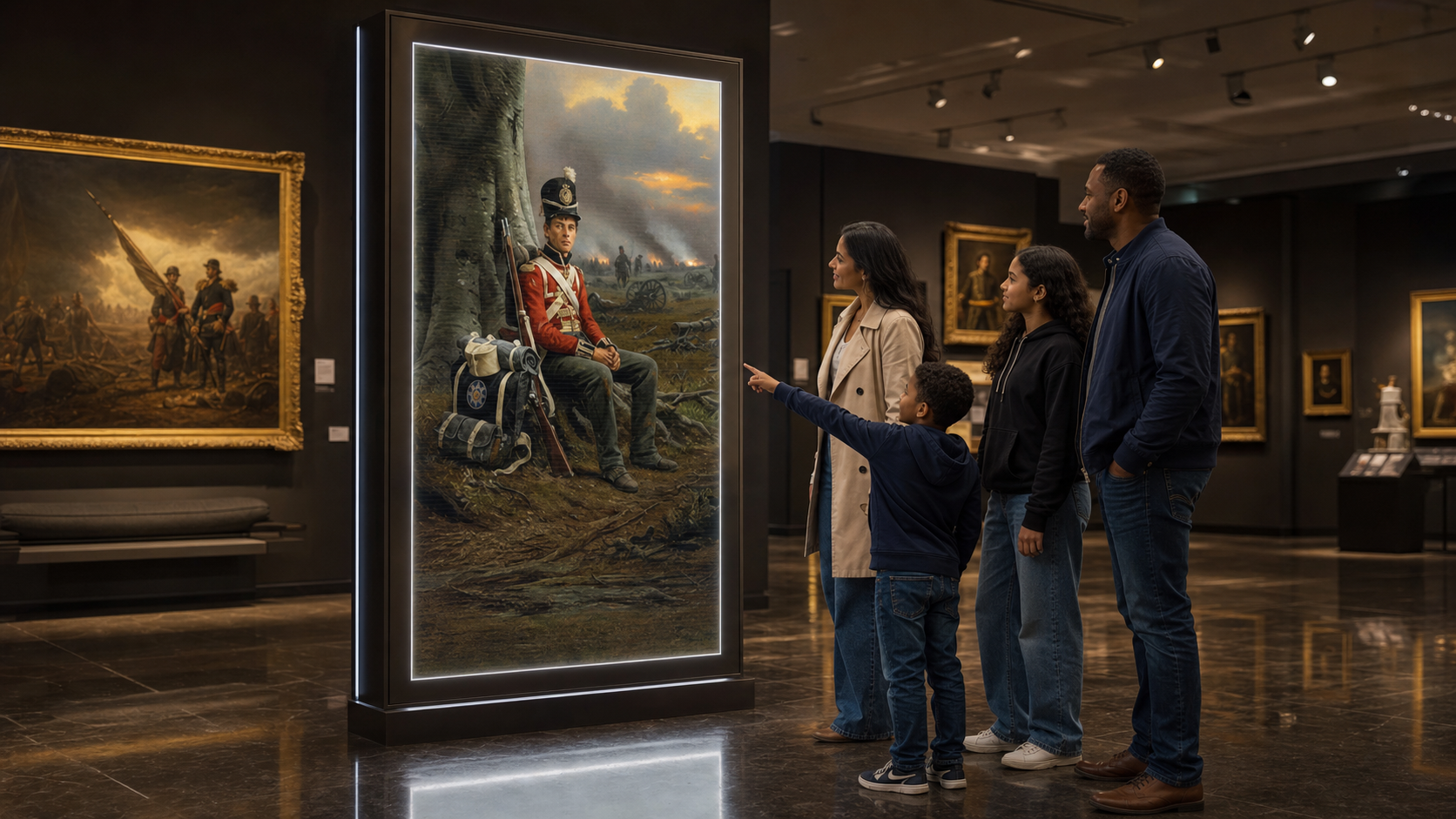
An audio guide delivers your script. An AI character answers their questions.
Audio guides cover the whole site efficiently. AI characters go deeper at the points that matter most. Different jobs. They can run side by side without overlap.
Audio guides are reliable and scalable for baseline content delivery. AI characters are responsive and data-generating. The roles are complementary, not competing.
Who this comparison is for
Curatorial teams, museum directors, and heritage operators evaluating whether an AI character replaces, complements, or competes with their existing audio guide programme.
Read on
Audio guides aren't replaced. AI characters deploy at high-footfall points where visitor volume justifies the screen.
Phase the rollout
Site-wide coverage stays cheap with audio. Premium engagement at flagship exhibits via AI character. Most sites end up running both.
What each one actually does
Audio Guide
- Fixed script, one-way delivery
- Decided in post-production
- Every visitor gets the same content
- Available in a handful of languages
- Handheld device
- Works without WiFi
Lumière AI
- Brings stories to life in real time, in conversation
- Governed by your curators
- multiple languages in real time
- Deployed on screen or holographic display
- Generates data on every question asked
What each one does
| Capability | Audio Guide | Lumière AI |
|---|---|---|
| Pre-recorded delivery | ✓ Curator-controlled, never deviates | ✕ Live conversation instead |
| Answers visitor's specific question | ✕ Plays prepared content only | ✓ Yes, in real time |
| Real-time language switching | ✕ Pre-recorded tracks, fixed at start | ✓ Mid-conversation, multiple languages |
| Visitor intent data | ✕ No | ✓ Full question log |
| No hardware at point of display | ✓ Handheld | ✕ Requires screen |
| Works without WiFi | ✓ Often | ✕ Requires connection |
| Curator-governed content | ~ Post-production only | ✓ Ongoing knowledge base |
| Engages school groups interactively | ✕ No | ✓ Yes |
| Updates without re-recording | ✕ No | ✓ Yes |
| Knowledge-base gap reports | ✕ No | ✓ Yes |
What each one does better
Audio guides are better at
Cost-effective, hardware-free content delivery across a whole site. No WiFi required, no screens, scales to hundreds of simultaneous visitors cheaply. For sites with limited budgets and stable content, audio guides still make sense.
Lumière AI is better at
Responsive, multilingual, data-generating engagement. A French school group, a Japanese tourist, and a local visitor all want different things. An AI character gives each of them what they ask for, in their language, in real time. Every question improves the knowledge base for the next visitor.
The reality
Visitor expectations are shifting. School groups expect interactivity. International visitors need real-time language support. The AI character isn't just a better audio guide. It's a fundamentally different kind of visitor engagement. The two can coexist: audio guides for site-wide coverage, AI characters at the highest-footfall points. Neither makes the other redundant. The audio guide covers the breadth. The AI character covers the depth.
Questions about audio guides and AI characters
Can we keep our audio guides and add an AI character?
How does the AI character maintain historical accuracy?
Can the AI character be based on a real historical figure?
What happens if a visitor asks something the character doesn't know?
Want to see what this looks like at your museum?
Twenty minutes. We'll show you Private Forsythe running at Waterloo Uncovered, and walk through what a character would look like at your site.